
Deep space CubeSat mission
IZIHAMBO-1
Moon - Mars - Asteroid
Izihambo, a Zulu word meaning Journeys, Travels, or Expeditions, is a cost-efficient 12U deep space CubeSat mission. Injected onto a trans-lunar trajectory, it uses a lunar flyby to enter heliocentric orbit and targets Mars and a near-Earth asteroid with a Mars descent probe relay demo.
Platform12U deep space CubeSat
Mass class14 kg spacecraft
Power300 W at Earth
Launch profileDirect TLI + lunar flyby
Mars demoProbe release + relay
Budget targetZAR 247,461,000 (~$15 million)
Mission snapshot
Built for deep space, light by design
A launch provider places IZIHAMBO-1 on direct TLI, using the lunar flyby to enter heliocentric orbit in about a week. Low-thrust cruise adds 3.0-3.5 km/s over 221-258 days, releasing the descent probe weeks before Mars for relay and imaging ahead of the NEA retarget.
Mission objectives
Four goals guiding the architecture
IZIHAMBO-1 balances affordability with technical ambition while targeting firsts for South Africa in deep space.
- Goal 01
Cost-efficient interplanetary access
Demonstrate that interplanetary space can be accessed affordably while still enabling meaningful science.
- Goal 02
High-resolution imaging
Return high-resolution imagery of the Moon, Mars, and a near-Earth asteroid.
- Goal 03
Mars descent probe demo
Deploy a sub-2 kg probe to validate small-scale Mars entry, descent, and relay.
- Goal 04
South Africa firsts
Position South Africa as the fourth nation to land hardware on Mars.
Flight plan
Gravity assists and ion propulsion
A direct insertion and lunar assist set the heliocentric cruise, followed by low-thrust shaping to Mars and a near-Earth asteroid.
Direct TLI insertion
Launch provider places the spacecraft directly onto a trans-lunar injection. Low-thrust LEO spirals were discarded because BIT-3 thrust is too low for effective Oberth gains.
Lunar flyby + heliocentric orbit
Lunar gravity assist inserts IZIHAMBO-1 into heliocentric orbit roughly one week after launch.
Ion-propelled cruise to Mars
3.0-3.5 km/s of delta-V is accumulated over 221-258 days of thrusting, reaching Mars about 9-12 months after heliocentric injection.
Mars encounter + NEA flyby
Probe released weeks prior; the spacecraft diverts to miss the atmosphere, images Mars, relays probe data, then retargets a near-Earth asteroid.
Spacecraft architecture
Subsystems tuned for long-duration cruise
Commercial components anchor the Phase A baseline, balancing deep space capability with CubeSat constraints.
Propulsion
Ion propulsion
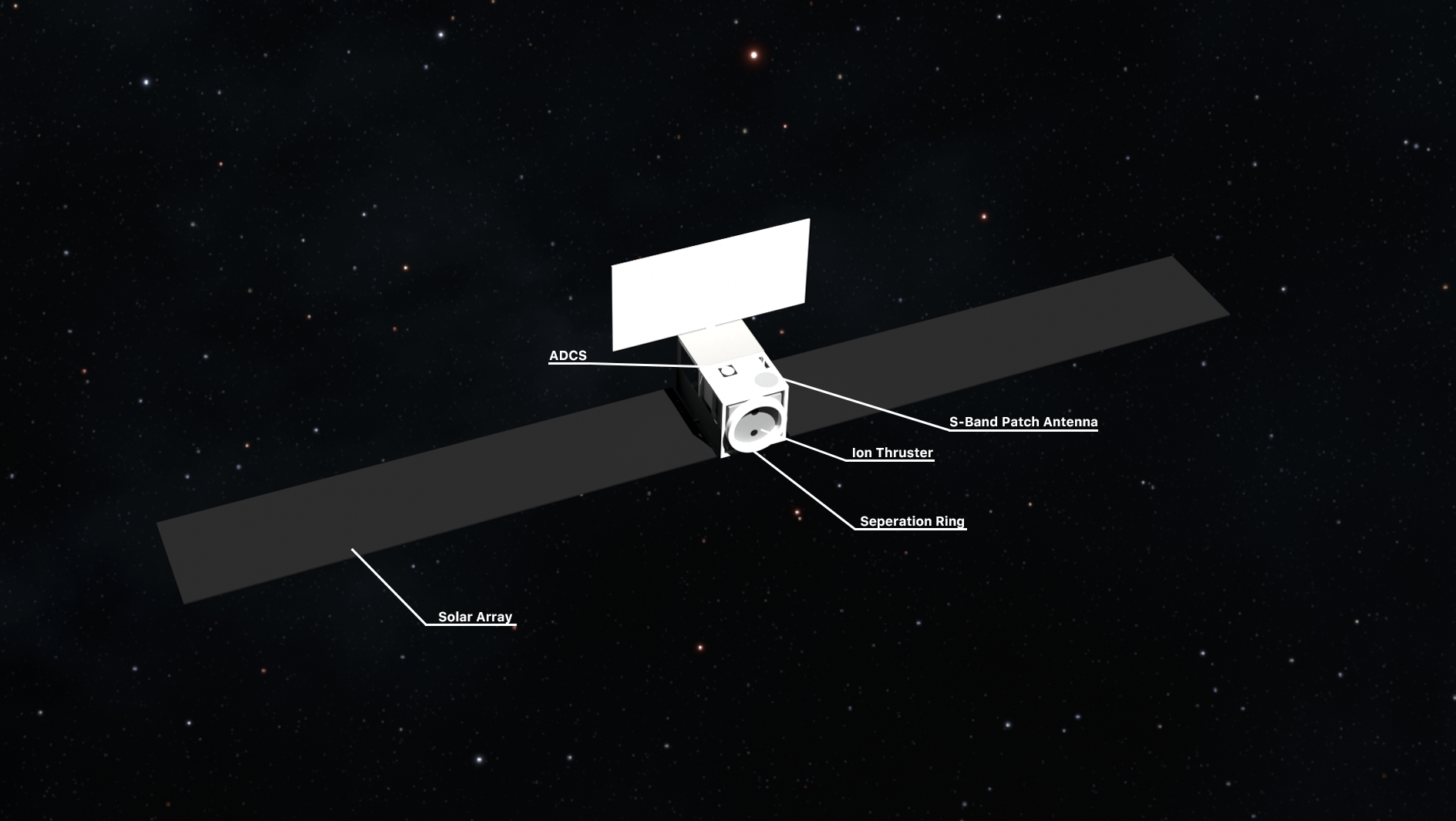
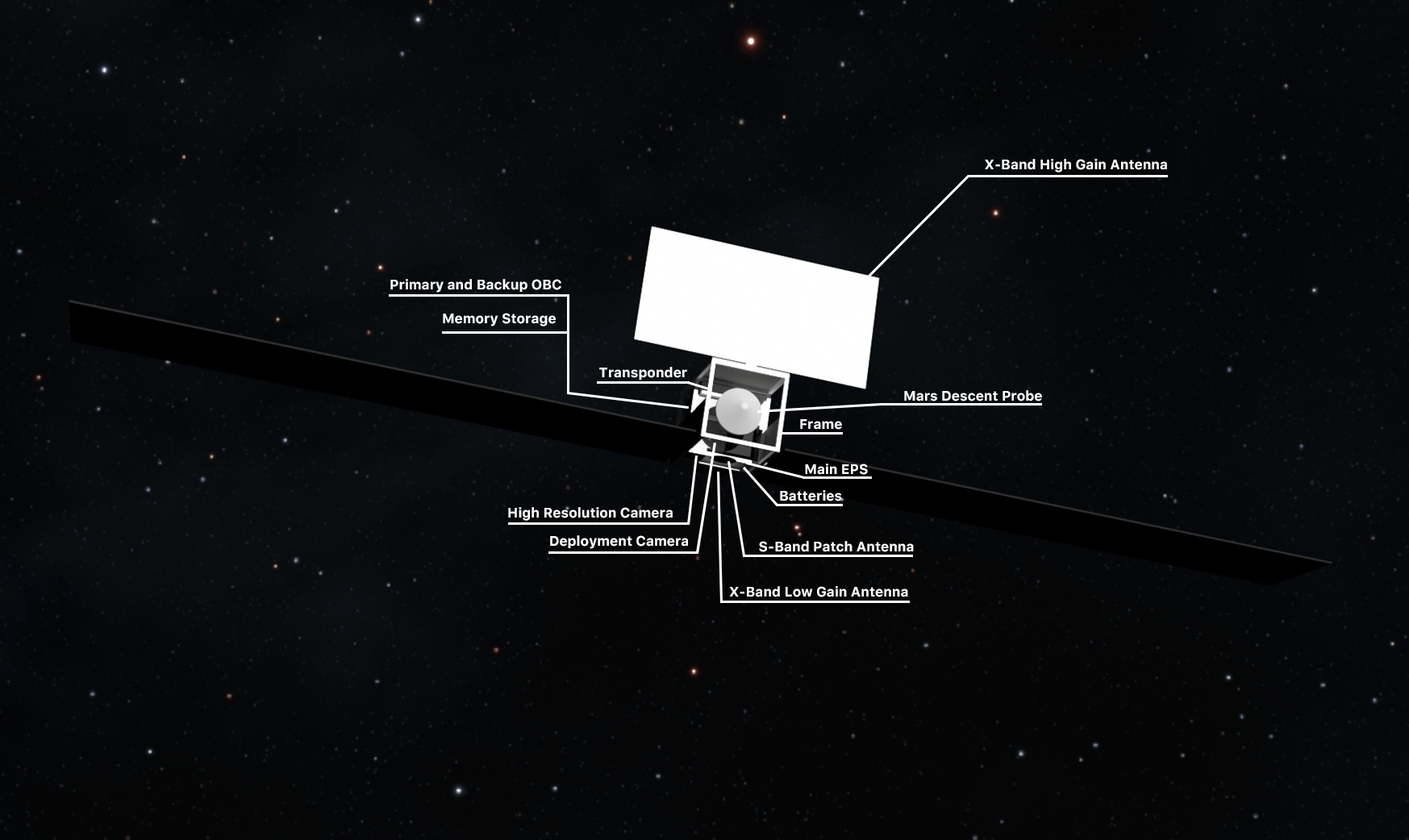
2x Busek BIT-3 ion thrusters, 2.2 mN combined thrust, gimbaled for wheel desaturation.
Power
Power generation
2x ExoTerra 150 W arrays (300 W at Earth, 108-158 W at Mars) with NanoPower EPS and 100 Wh battery.
Comms
Deep space communications
Anywaves X-band reflectarray high gain, EnduroSat X-band patch, and dual Anywaves S-band antennas.
GNC
Navigation + GNC
Blue Canyon XACT-50 ADCS with arcsecond-class pointing for imaging.
Avionics
Avionics + storage
Xiphos primary OBC with EnduroSat backup and up to 1 Tb radiation-tolerant storage.
Payload
Payload + imaging
CrystalSpace CS-292 67 MP primary camera plus CS-101 5 MP deployment camera.
3D model
Interactive spacecraft view
Tip: Drag in any direction or scroll to zoom. Use expand view for immersion.
Science and operations
Imaging, relay, and data return
The payload and communications stack prioritize high-value imaging and keep data flowing through the Mars probe descent.
Imaging and data
- CrystalSpace CS-292 67 MP primary camera
- CS-101 5 MP deployment camera for probe release
- Up to 1 Tb radiation-tolerant storage (4x 256 Gb)
- Primary vs secondary data prioritization for downlink
Communications
- Anywaves X-band reflectarray high gain antenna
- EnduroSat X-band patch array + 2x Anywaves S-band antennas
- Vulcan Wireless X/S transponder
- Ground station trades for DSN or KSAT 13-32 m antennas
Mission risks
Mitigations defined in Phase A
Technical risks are identified early to preserve science return and mission resilience.
Ion propulsion dependency
- Loss of one BIT-3 likely removes the Mars intercept but enables NEA retargeting
- Loss of both thrusters prevents reaction wheel desaturation
- Cold gas thrusters are a mitigation option for desaturation
High-gain antenna deployment
- Failure reduces data rate but mission can continue
- Low-gain X-band and S-band provide backup links
- Earth flyby data dump could recover science return
High-resolution camera
- Loss of the CS-292 removes high-resolution imaging
- CS-101 deployment camera can capture lower-quality imagery
- Structure can partially obstruct the CS-101 field of view
Solar array deployment
- Single array limits thrusting to one BIT-3 at a time
- Passive backup array could preserve essential power
- Dual array loss forces battery-only contingency operations
Program plan
From feasibility to flight
Phase B is a risk-reduction study to PDR, followed by Phase C/D build and Phase E operations.
Phase B proposes a 12-month risk-reduction study to deliver a PDR-ready baseline with ZAR 41,115,000. Phases C and D are funded together, with CDR and design freeze in Phase C (6-9 months) and build, test, and launch in Phase D (18-24 months) for ZAR 165,231,000, followed by 24 months of Phase E operations at ZAR 41,115,000. Total mission estimate: ZAR 247,461,000 (~$15 million).
Phase A feasibility
Baseline mission architecture, objectives, and cost range definition.
Phase B mission study + PDR
12-month risk-reduction study leading to a PDR-ready baseline.
Phase C CDR + design freeze
Complete CDR and freeze the spacecraft configuration.
Phase D build + launch
Integration, test, and launch services.
Phase E operations
Mission operations and data return.
Partner with us
Build South Africa's next deep space milestone
Targets the Moon, Mars, and a near-Earth asteroid with a Mars descent probe relay demo.
Mission status
Phase A feasibility complete, with Phase B proposed as a 12-month mission study leading to PDR.